
Treatment Options
Every Person's PET Journey Is Different
Patulous Eustachian Tube affects each person differently. The severity of symptoms, underlying causes, overall health, and personal treatment goals all influence which therapies may be appropriate.
There is no single treatment that works for everyone. Many people improve with conservative, non-surgical care, while others may benefit from office-based procedures or surgery after a thorough evaluation by an experienced otologist, neurotologist, or other clinician familiar with PET.
Treatment decisions should be individualized and based on symptoms, examination findings, contributing factors, and response to previous therapies. PET care is often staged and iterative, meaning patients and physicians may need to try more than one approach before finding the best balance of symptom relief and preserved Eustachian tube function.
1. Confirming the Diagnosis
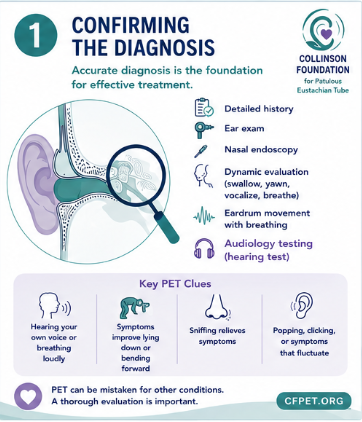
PET can be mistaken for other conditions, including Obstructive Eustachian Tube Dysfunction (oETD), Superior Semicircular Canal Dehiscence (SCDS), temporomandibular disorder (TMD), migraine-related ear symptoms, inner-ear conditions, and other causes of autophony or ear fullness.
Many PET patients describe their ear as blocked, full, muffled, or clogged, even when hearing tests are normal. This wording can be misleading because the problem may actually be an abnormally open Eustachian tube. Important PET clues may include:
Hearing your own voice loudly or echoing in your head (voice autophony)
Hearing your own breathing loudly (breath autophony)
Symptoms that improve when lying down, or putting the head in a lowered position
Frequent sniffing to temporarily relieve symptoms
Popping, clicking, or symptoms that fluctuate during the day
Symptoms that worsen with dehydration, exercise, rapid weight loss, allergy flares, reflux, or jaw/muscle tension
A PET specialist may use a combination of history, ear examination, nasal endoscopy, and sometimes imaging. Because the Eustachian tube functions like a valve, a static exam may miss important findings. Dynamic endoscopy while the patient swallows, yawns, vocalizes, or breathes can help assess how well the valve opens and closes. Seeing the eardrum move with breathing can also support the diagnosis.
2. Identifying Contributing Factors
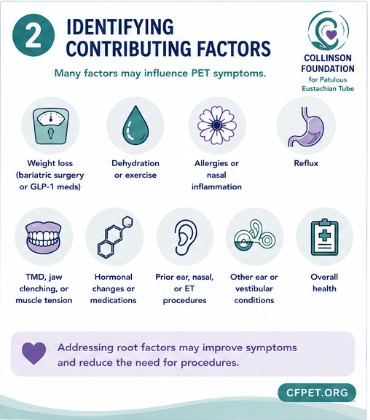
After diagnosis, the next step is to look for factors that may be contributing to PET. Addressing these factors may improve symptoms and may reduce the need for procedures.
Your physician may evaluate:
Recent or rapid weight loss, including weight loss after bariatric surgery or GLP-1 medications
Dehydration or symptoms that worsen with exercise
Allergic rhinitis or chronic nasal inflammation
Reflux
TMD, jaw clenching, muscle tension, or anxiety-related muscle tightening
Pregnancy, hormonal changes (perimenopause), or medication-related changes
Prior ear, nasal, sinus, or Eustachian tube procedures
Other ear or vestibular conditions that can mimic PET
Although allergies are often associated with obstructive ETD, chronic allergic inflammation may also be associated with PET in some patients. In these cases, the goal for allergy management becomes to reduce inflammation while avoiding unnecessary drying of the Eustachian tube lining.
3. Conservative Treatment
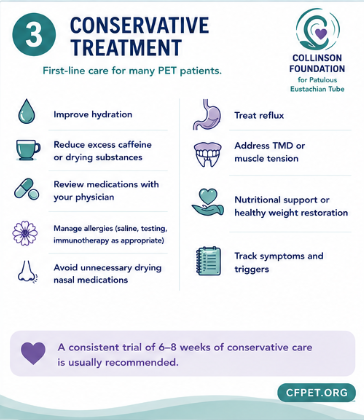
For many people, conservative care is the first and most important step.
Conservative approaches may include:
Improving hydration, especially if symptoms worsen with exercise or dehydration
Reducing excessive caffeine, stimulants, or other drying substances
Reviewing medications with a physician to identify anything that may worsen dryness or symptoms
Managing allergies which may include environmental measures, saline irrigation, allergy testing, or immunotherapy
Avoiding unnecessary nasal decongestants or drying nasal medications unless specifically recommended
Treating reflux when present
Addressing TMD, jaw clenching, or muscle tension through dental, oral medicine, physical therapy, or other non-surgical approaches
Nutritional support or healthy weight restoration when medically appropriate
Tracking symptom patterns, including posture, hydration, exercise, meals, allergy exposure, stress, menstrual or hormonal changes, and medication changes
Some physicians may recommend topical therapies aimed at wetting or mildly irritating the Eustachian tube lining. These may include saline drops, saline irrigations, hypertonic saline, citric acid preparations (such s PatulEND), or other physician-directed drops.
A consistent trial of 6-8 weeks of conservative treatment is usually recommended before deciding whether to move to the next step.
4. Office-Based or Minimally Invasive Procedures
Injection or filler procedures
Fillers may be used to narrow small defects near the Eustachian tube valve. These tend to work best for smaller, well-positioned defects and may need to be repeated because some materials are absorbed over time. Examples of fillers that are actively being used at this time include:
Hyaluronic Acid (HA)
The same class of filler commonly used in cosmetic procedures.
Temporary because it is eventually absorbed and may require repeat injections.
Autologous Fat (comes from your own body)
Injected after being processed or minced.
Variable long-term survival
Calcium Hydroxyapatite (CaHA)
Currently the longest-lasting filler currently available in routine practice.
Commercial example: Radiesse®
Shim procedures
A small flexible piece of material (angiocath ) may be placed into the Eustachian tube to help partially block the tube.
The goal of these procedures is not to close the Eustachian tube completely. A healthy Eustachian tube still needs to ventilate and drain the middle ear. Overcorrection can create obstructive symptoms or middle-ear fluid.
Some specialists offer procedures that can be performed in an office setting before considering more complex surgery. Not every patient is a candidate, and availability varies widely by physician based on skills and experience.
Tympanic membrane paper patching or mass loading
Adding temporary weight or thickness to the eardrum may reduce bothersome movement from breathing-related pressure changes. This may be especially helpful for patients whose main symptom is breath autophony. Examples of materials used for mass loading include:
adhesive strips
paper patching
various ointments
Ear tubes can be inserted as a method of mass loading, however, some PET patients find then uncomfortable because they can change sound resonance.
5. Surgical Treatment Options
When symptoms remain severe despite conservative care and less invasive procedures, surgery may be considered. PET surgery is typically reserved for carefully selected patients after a comprehensive evaluation.
The goal of PET surgery is to reduce the abnormal openness of the Eustachian tube while preserving as much normal function as possible and should only be considered after conservative and office-based treatments have been exhausted. Surgical approaches vary by specialist and may include:
Cartilage implant around the Eustachian tube valve. Cartilage is often harvested from one’s opposing targus
Permanent tympanic membrane mass-loading procedures, such as cartilage tympanoplasty
In addition to procedures related directly to the ET opening, some doctors will evaluate the condition and state of the patient's sinus cavity. Having adequate sinus function is paramount to maintaining the ET opening. Sinus procedures may include:
Deviated septum repair
Turbinate reduction
Sinus balloon dilation
Before certain procedures, a physician may order imaging, such as a CT scan. Imaging can help assess the Eustachian tube and identify important anatomy, including the relationship of the internal carotid artery to the Eustachian tube and also identify or rule out SCDS.
Understanding Success Rates and Expectations
One of the most common questions patients ask is, “Which treatment works best?”
Unfortunately, there is no single answer. PET treatment is highly individualized. Some people improve with hydration, allergy care, TMD treatment, or topical therapies. Others may need an office procedure or surgery. Some procedures may need multiple surgeries with negligible progress.
The best treatment depends on the patient’s symptoms, anatomy, suspected cause, severity, and response to previous treatments. A treatment that helps one person may not help another.
It is also important to understand that PET treatment often aims for improvement rather than perfection. Because the Eustachian tube has an important normal job, the goal is to reduce abnormal openness without creating a tube that is too closed.